
Debt is lower relative to GDP, but still growing in dollars
Debt is lower than the latest Budget forecast and has fallen as a share of GDP, but it has still risen in dollars. The October 8 accounts put net core Crown debt at $186.8bn, up $4.6bn in a year; the current forecast also adds debt before a later decline.
What was claimed
Paraphrase · not a direct quotation · New Zealand National Party
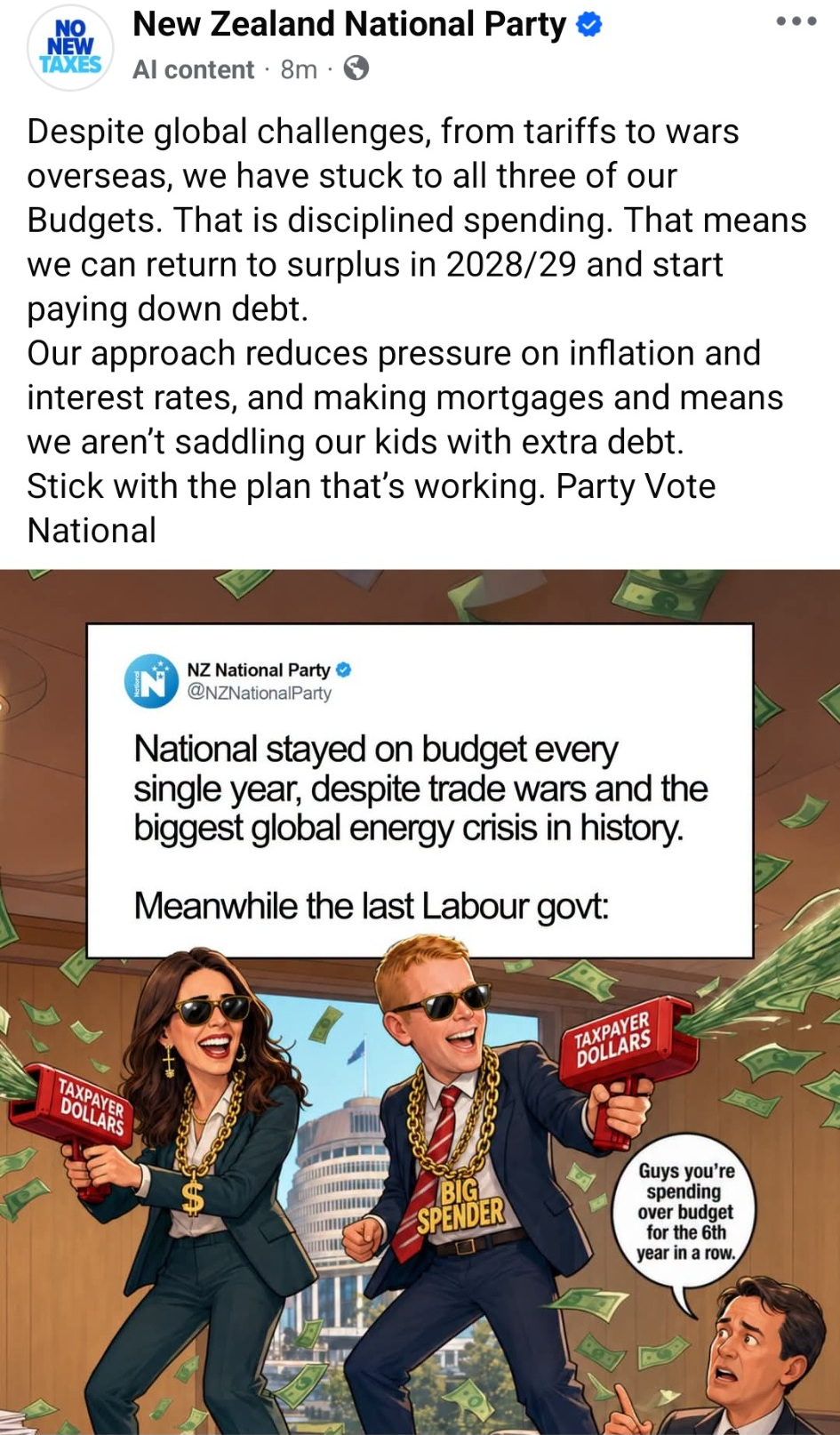
National says its approach means it is not saddling children with extra debt.
Original post date not recovered. Reader reports a post seen on 13 October 2026. The relative Facebook timestamp does not independently establish its absolute publication date.
- Supplied capture of New Zealand National Party Facebook postReader-supplied screenshot transcribed for this check. The exact post date and permalink are not established by the capture.
Context and implied message
Our interpretation: the present-tense phrasing can leave readers with the impression that debt is no longer being added, rather than merely lower than an updated forecast.
What the evidence establishes: Latest actual debt rose in dollars despite improving against GDP and the Budget2026 forecast. Future debt reductions remain conditional. The post gives no specific alternative-party counterfactual, so the rating does not invent one.
Read the surrounding wording
Paraphrase of the source context · not a direct quotation
The caption says disciplined Budgets mean returning to surplus and paying down debt, then says National is not saddling children with extra debt.
Supplied capture of New Zealand National Party Facebook post · Financial Statements of the Government for the Year Ended 30 June 2026 · Pre-election Economic and Fiscal Update2026
Why this rating
Misleading for the present impression that debt is no longer being added. The October accounts record an increase in net core Crown debt of $4.613bn over the year to June 2026.
The favourable context matters too: debt fell relative to GDP and was lower than the updated Budget forecast. A lower ratio or lower-than-forecast debt is a different claim from no additional debt.
The current forecast adds nominal debt until 2029/30, then reduces it in 2030/31. That is a conditional forecast, not debt already repaid.
The phrase about children is a political value judgement. If “extra” means less borrowing than a future Labour counterfactual, that is an unspecified prediction. This check does not invent that comparison or judge whether borrowing for public investment is worthwhile.
The numbers and definitions
Latest recorded debt
- Claim stated
- Not adding extra debt
- Evidence
- $186.784bn versus $182.171bn: +$4.613bn
- Period / measure
- 30 June 2026 vs30 June 2025, same October 8 financial statements
Debt share of GDP
- Claim stated
- Debt management
- Evidence
- 40.9% versus41.8%: -0.9 percentage points
- Period / measure
- 30 June 2026 vs30 June 2025; revised nominal GDP series
Debt compared with updated Budget
- Claim stated
- Debt restraint
- Evidence
- $186.784bn actual versus$191.761bn Budget2026 forecast: $4.977bn lower
- Period / measure
- 2025/26 year; comparator published28 May 2026
Missing context and limits
- The post does not name a Labour counterfactual or quantify “extra”. If meant relative to an alternative party’s future path, that comparison has not been established here.
- The rating covers the present no-additional-debt impression, not a verdict on an uncertain future surplus or the desirability of public borrowing.
- Debt also reflects inherited policies, macroeconomic conditions, assets, timing and borrowing for capital investment; this is not a claim that one party alone caused its increase.
Primary sources and verification
AI-assisted review of the supplied claim and the identified primary documents. Numerical comparisons were reproduced where stated. Retrieval gaps are disclosed; no external human editorial review was performed.
Financial Statements of the Government for the Year Ended 30 June 2026The Treasury · official record
Table1 revised actual debt186784m/182171m; debt GDP40.9/41.8%; Budget2026 forecast191761m. Table2 distinguishes PREFU unaudited186703m.
Published 8 Oct 2026. Accessed 13 Oct 2026.
Read the source ↗Pre-election Economic and Fiscal Update2026The Treasury · official record
Printedp21 describes temporary expansionary fiscal impulse2026/27, then contraction from2027/28 with caveats; p45 forecast debt186.7bn to232.8bn2029/30, then229.8bn2030/31. Future amounts are forecasts;2026 actual starting point has since been revised.
Published 29 Sept 2026. Accessed 13 Oct 2026.
Read the source ↗Correction and revision history · 1 version
- Version 1 · 13 Oct 2026
Initial source review of the supplied campaign claim. The conclusion is limited to the stated scope and evidence; unresolved assertions are identified explicitly.
Debt is lower than the latest Budget forecast and has fallen as a share of GDP, but it has still risen in dollars. The October 8 accounts put net core Crown debt at $186.8bn, up $4.6bn in a year; the current forecast also adds debt before a later decline.
Statement, context and sources in this version
National says its approach means it is not saddling children with extra debt.
Full message assessed · Context paraphrase
The caption says disciplined Budgets mean returning to surplus and paying down debt, then says National is not saddling children with extra debt.
Our interpretation: the present-tense phrasing can leave readers with the impression that debt is no longer being added, rather than merely lower than an updated forecast.
Latest actual debt rose in dollars despite improving against GDP and the Budget2026 forecast. Future debt reductions remain conditional. The post gives no specific alternative-party counterfactual, so the rating does not invent one.
- Supplied capture of New Zealand National Party Facebook post · accessed 13 Oct 2026
- Financial Statements of the Government for the Year Ended 30 June 2026 · accessed 13 Oct 2026
- Pre-election Economic and Fiscal Update2026 · accessed 13 Oct 2026
Published conclusions are retained when a new version changes the explanation or rating.
How we fact-check
We select specific, testable assertions from attributable statements and reader submissions. National and Labour face the same criteria. This is selected coverage, not a party scorecard or a claim that every campaign statement has been checked.
Evidence and ratings
We prioritise original statistics, legislation, agency documents and parliamentary records. A party’s statement establishes what it said; it is not independent proof against another party. For claims about a published plan, a reproduced calculation establishes its arithmetic, not whether its forecasts will happen.
Context matters
Checks identify the period, publication date and definition of each measure. We distinguish headcount from full-time equivalents, price levels from inflation, adjusted from unadjusted statistics, and forecasts from results.
Blame, credit and the full message
We read the surrounding words and images, including implied claims that a party caused a problem or deserves credit for an improvement. A correct number does not by itself prove that attribution. We label our interpretation, show the source context and explain what the evidence can establish. The same test applies to criticism by either party and to claims about its own achievements.
An attack is a reason to examine responsibility, not automatic proof of a falsehood or an unsupported motive. A recorded vote or directly implemented policy can support a specific claim. For wider outcomes, we look for evidence of the proposed causal link and consider other influences. Missing evidence does not prove a policy had no effect. Where accurate figures create a materially unsupported impression of blame or credit, the full message can be Misleading; where a conclusion cannot be established, we use Unverified. Future consequences remain predictions.
Each entry states its scope. “Full message assessed” includes the selected claim’s material factual implications, not every other assertion in the source. “Factual component checked” limits the rating to a documented action or assertion and explains broader implications separately. Promises, predictions and opinions receive context without an accuracy verdict.
Future promises, predictions and opinions
These entries explain what was proposed or argued. A future promise is a commitment whose delivery remains to be assessed; a prediction describes possible outcomes; an opinion expresses a judgement. We provide sources and context without assigning an accuracy verdict. Any testable factual assertions within these statements can be checked separately. A factual claim with insufficient evidence is labelled Unverified.
AI-assisted research and independence
The initial reports use AI-assisted research and calculations. Each report explains the sources read and the limits of its verification. External human editorial review has not been recorded for this initial batch. Sponsorship and newsletter distribution cannot change a verdict or replace the evidence requirements.
Corrections and incomplete information
Unresolved assertions remain Unverified or private drafts. A changed public conclusion retains the earlier rating, explanation and dated revision reason in its correction history. Readers can submit evidence, report an error or appeal a rating using the form below. Submissions require review before publication.
Checks describe the evidence available on their verification date. New statistics or a later policy announcement may change the answer; a later document does not establish what was true on an unknown earlier posting date.