
The 2026 energy shock is a record supply disruption
The IEA describes the 2026 Middle East conflict as the largest energy-security crisis and the largest global oil-supply disruption on record. “Biggest” still depends on the measure; this does not establish the highest prices or greatest cumulative economic harm.
What was claimed
Paraphrase · not a direct quotation · New Zealand National Party
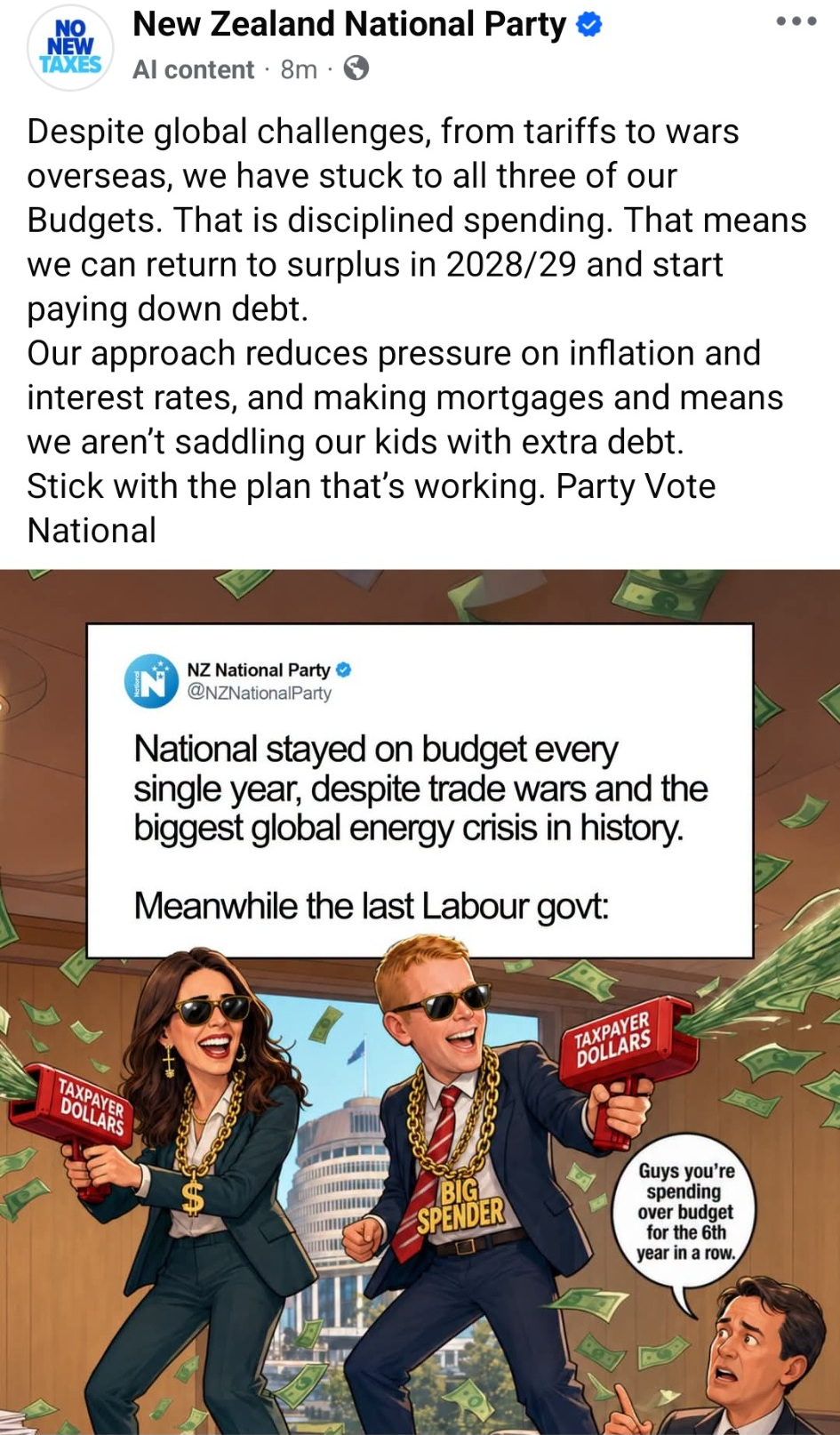
National refers to the biggest global energy crisis in history.
Original post date not recovered. Reader reports a post seen on 13 October 2026. The relative Facebook timestamp does not independently establish its absolute publication date.
- Supplied capture of New Zealand National Party Facebook postReader-supplied screenshot transcribed for this check. The exact post date and permalink are not established by the capture.
Context and implied message
Our interpretation: the energy phrase emphasises how difficult external conditions were while crediting National’s fiscal management.
What the evidence establishes: The external shock description is substantially supported by the IEA. The claim that National passed a consistent Budget-adherence test remains separately Unverified; the energy evidence does not settle it.
Read the surrounding wording
Paraphrase of the source context · not a direct quotation
The graphic places the energy crisis and trade wars alongside a claim that National stayed on Budget each year.
Supplied capture of New Zealand National Party Facebook post · Impacts of Middle East conflict set to reshape energy investment plans as disruptions put focus on security · Oil Market Report–March 2026 · 2026 Energy Crisis Policy Response Tracker
Why this rating
The party graphic’s energy description substantially matches the IEA’s assessment. The IEA’s 28 May 2026 news release attributes the largest energy-security crisis assessment to Executive Director Fatih Birol.
The March 12 Oil Market Report identifies a record global oil-market disruption; the September 30 response tracker retains the record-supply-disruption assessment.
The material qualification is measurement: supply disruption and energy-security risk are not the same as highest price, total output lost over the whole crisis or cumulative welfare damage. No universal across-all-metrics historical ranking was reproduced.
Missing context and limits
- Rate only the energy assertion. This verdict does not rate the Budget comparison, National’s fiscal competence, or forecasts in the same post.
- The IEA is authoritative independent evidence, but the superlative remains its assessment of energy security and supply disruption rather than an independently reproduced universal index.
Primary sources and verification
AI-assisted review of the supplied claim and the identified primary documents. Numerical comparisons were reproduced where stated. Retrieval gaps are disclosed; no external human editorial review was performed.
Impacts of Middle East conflict set to reshape energy investment plans as disruptions put focus on securityInternational Energy Agency · official record
Agency’s own release attributes the largest-ever energy-security crisis assessment to Executive Director Fatih Birol.
Published 28 May 2026. Accessed 13 Oct 2026.
Read the source ↗Oil Market Report–March 2026International Energy Agency · official record
Public highlights call the conflict the largest disruption in global oil-market supply history.
Published 12 Mar 2026. Accessed 13 Oct 2026.
Read the source ↗2026 Energy Crisis Policy Response TrackerInternational Energy Agency · official record
Page updated30 September 2026 describes record supply disruption; update date is not original publication date.
Publication date not stated. Accessed 13 Oct 2026.
Read the source ↗Correction and revision history · 1 version
- Version 1 · 13 Oct 2026
Initial source review of the supplied campaign claim. The conclusion is limited to the stated scope and evidence; unresolved assertions are identified explicitly.
The IEA describes the 2026 Middle East conflict as the largest energy-security crisis and the largest global oil-supply disruption on record. “Biggest” still depends on the measure; this does not establish the highest prices or greatest cumulative economic harm.
Statement, context and sources in this version
National refers to the biggest global energy crisis in history.
Factual component checked · Context paraphrase
The graphic places the energy crisis and trade wars alongside a claim that National stayed on Budget each year.
Our interpretation: the energy phrase emphasises how difficult external conditions were while crediting National’s fiscal management.
The external shock description is substantially supported by the IEA. The claim that National passed a consistent Budget-adherence test remains separately Unverified; the energy evidence does not settle it.
- Supplied capture of New Zealand National Party Facebook post · accessed 13 Oct 2026
- Impacts of Middle East conflict set to reshape energy investment plans as disruptions put focus on security · accessed 13 Oct 2026
- Oil Market Report–March 2026 · accessed 13 Oct 2026
- 2026 Energy Crisis Policy Response Tracker · accessed 13 Oct 2026
Published conclusions are retained when a new version changes the explanation or rating.
How we fact-check
We select specific, testable assertions from attributable statements and reader submissions. National and Labour face the same criteria. This is selected coverage, not a party scorecard or a claim that every campaign statement has been checked.
Evidence and ratings
We prioritise original statistics, legislation, agency documents and parliamentary records. A party’s statement establishes what it said; it is not independent proof against another party. For claims about a published plan, a reproduced calculation establishes its arithmetic, not whether its forecasts will happen.
Context matters
Checks identify the period, publication date and definition of each measure. We distinguish headcount from full-time equivalents, price levels from inflation, adjusted from unadjusted statistics, and forecasts from results.
Blame, credit and the full message
We read the surrounding words and images, including implied claims that a party caused a problem or deserves credit for an improvement. A correct number does not by itself prove that attribution. We label our interpretation, show the source context and explain what the evidence can establish. The same test applies to criticism by either party and to claims about its own achievements.
An attack is a reason to examine responsibility, not automatic proof of a falsehood or an unsupported motive. A recorded vote or directly implemented policy can support a specific claim. For wider outcomes, we look for evidence of the proposed causal link and consider other influences. Missing evidence does not prove a policy had no effect. Where accurate figures create a materially unsupported impression of blame or credit, the full message can be Misleading; where a conclusion cannot be established, we use Unverified. Future consequences remain predictions.
Each entry states its scope. “Full message assessed” includes the selected claim’s material factual implications, not every other assertion in the source. “Factual component checked” limits the rating to a documented action or assertion and explains broader implications separately. Promises, predictions and opinions receive context without an accuracy verdict.
Future promises, predictions and opinions
These entries explain what was proposed or argued. A future promise is a commitment whose delivery remains to be assessed; a prediction describes possible outcomes; an opinion expresses a judgement. We provide sources and context without assigning an accuracy verdict. Any testable factual assertions within these statements can be checked separately. A factual claim with insufficient evidence is labelled Unverified.
AI-assisted research and independence
The initial reports use AI-assisted research and calculations. Each report explains the sources read and the limits of its verification. External human editorial review has not been recorded for this initial batch. Sponsorship and newsletter distribution cannot change a verdict or replace the evidence requirements.
Corrections and incomplete information
Unresolved assertions remain Unverified or private drafts. A changed public conclusion retains the earlier rating, explanation and dated revision reason in its correction history. Readers can submit evidence, report an error or appeal a rating using the form below. Submissions require review before publication.
Checks describe the evidence available on their verification date. New statistics or a later policy announcement may change the answer; a later document does not establish what was true on an unknown earlier posting date.