
National’s nine-tax graphic: real proposals, unresolved counting
The parties propose real tax changes, but the nine-label count is not independently established. It mixes new tax bases, existing rate changes and overlapping categories; the reviewed papers do not establish one agreed coalition package.
What was claimed
Paraphrase · not a direct quotation · New Zealand National Party
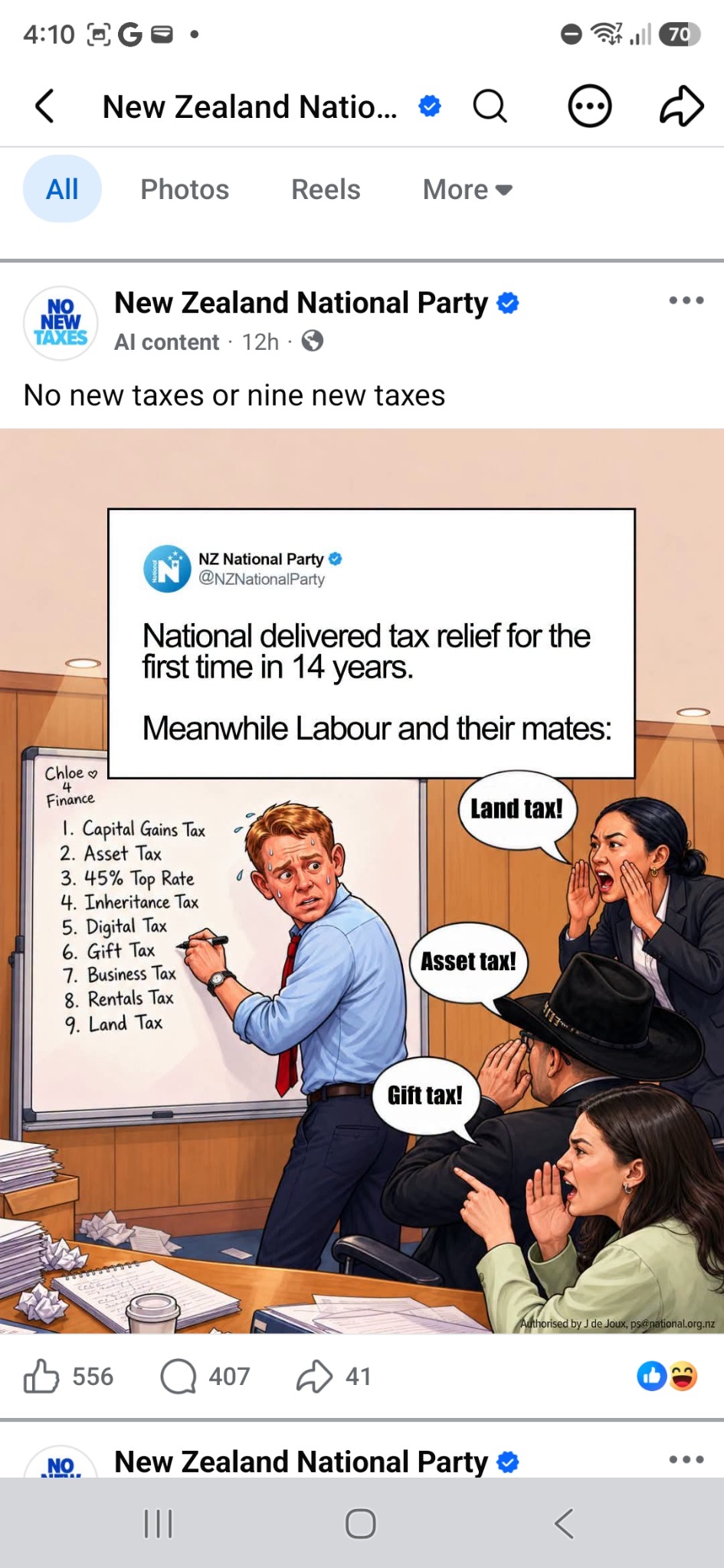
Labour and its allies propose nine new taxes: capital gains, assets, a 45% top rate, inheritance, digital, gifts, business, rentals and land.
Original post date not recovered. Original screenshot post date not recovered; relative Facebook timestamps have not been converted to dates. Equivalent dated statements are identified separately.
- Supplied screenshot: 1000211186.jpgReader-supplied screenshot transcribed for this check. The exact post date and permalink are not established by the capture.
Why this rating
Unverified for the precise count of nine distinct new taxes. The graphic supplies nine labels but no item-by-item policy references or counting rule. The policy examples below explain relevant proposals; they are not a claimed reconstruction of National’s intended mapping.
Labour’s property capital-gains proposal covers future gains on commercial and residential investment property, with family homes and farms exempt. Te Pāti Māori’s paper includes graduated wealth rates, a higher company rate, land-banking and other measures. Opportunity proposes an annual land tax. These are separate party programmes.
The Greens put gifts and inheritances within one capital-acquisitions proposal. Their higher top income and company rates change existing taxes; their digital withholding proposal is framed as enforcement. Splitting categories or calling every amendment a new tax changes the counting convention.
IRD confirms that income tax, company tax and rental-income taxation already exist. A proposal to increase a rate or alter deductions can create additional liabilities without creating a distinct tax instrument.
This review neither establishes that opposition parties propose no other taxes nor replaces nine with a different total. A final count requires National’s references and a stated rule for treating shared proposals, rate changes, exemptions and enforcement.
The numbers and definitions
Capital-gains label
- Claim stated
- Capital gains tax
- Evidence
- Labour: 28% on future commercial/investment-property gains after 1 July 2027; home and farm exempt.
- Period / measure
- Proposal, not enacted
Asset label
- Claim stated
- Asset tax
- Evidence
- Green wealth proposal: 2.5% above $10m, family home exempt. Te Pāti Māori has different graduated wealth settings.
- Period / measure
- Separate proposals; example mapping only
45% label
- Claim stated
- 45% top rate
- Evidence
- Green proposal: marginal 45% above $160,000. Existing income tax already has a 39% top band.
- Period / measure
- Proposed rate change
Inheritance and gift labels
- Claim stated
- Two labelled taxes
- Evidence
- Green paper puts both under one 33% capital-acquisitions proposal above $1m, with home/farm exemptions.
- Period / measure
- One proposal covering two transfer categories
Digital label
- Claim stated
- Digital tax
- Evidence
- Green paper describes 5% withholding enforcement; Te Pāti Māori proposes 5% on profits transferred offshore.
- Period / measure
- Different proposals; intended mapping unconfirmed
Business label
- Claim stated
- Business tax
- Evidence
- Green: 33% for companies above $30m turnover. Te Pāti Māori: 33% company rate. Existing standard rate: 28%.
- Period / measure
- Changes to existing company tax
Green Party of Aotearoa New Zealand · Te Pāti Māori · Inland Revenue
Rentals label
- Claim stated
- Rentals tax
- Evidence
- Rental income already incurs income tax. The graphic does not identify whether this label means deductions, land-sale rules or another instrument.
- Period / measure
- Intended policy not specified
Land label
- Claim stated
- Land tax
- Evidence
- Opportunity proposes 1.75% urban / 0.5% rural annually; Te Pāti Māori separately proposes a land-banking measure.
- Period / measure
- Different bases; not one agreed coalition rate
Missing context and limits
- National’s item-by-item mapping, calculation date and definition of a new tax were not recovered. The examples are possible matches, not definitive assignments to its nine labels.
- The reviewed policy papers do not establish an agreed future coalition tax programme. Alternative or overlapping proposals must not automatically be treated as cumulative.
- This is not a household-cost forecast or a full enumeration of every tax proposal from the parties.
- The original screenshot’s publication date remains unknown; live policy papers may have changed since it was posted.
Primary sources and verification
AI-assisted review: inspected the supplied graphic, full Green, Te Pāti Māori and Opportunity tax papers, Labour’s CGT page and IRD’s current tax definitions. Verified the stated proposal examples and category overlap. National’s complete nine-item mapping remains unavailable, so the numerical count is Unverified. No external human editorial review occurred.
No new taxes under NationalNational Party · party statement
Data period: 2026 election coalition-tax claim. Publication date not stated. Accessed 13 Oct 2026.
Read the source ↗Capital Gains Tax to Level the Playing Field for Businesses, Create Jobs and Fix New Zealand’s Health SystemNew Zealand Labour Party · party statement
Data period: 28% proposed property CGT on gains after 1 July 2027. Publication date not stated. Accessed 13 Oct 2026.
Read the source ↗A tax system for all of us – 2026 tax policyGreen Party of Aotearoa New Zealand · party statement
Full official party PDF read. Relevant tax definitions are on physical PDF pages 5–9; it is primary evidence of Green proposals, not independent evidence of their economic effects.
Data period: Proposed 2027/28–2030/31 tax settings. Publication date not stated. Accessed 13 Oct 2026.
Read the source ↗It’s time for a Tax ResetOpportunity Party · party statement
Source states May 2026; do not infer a day. Land tax is 1.75% urban and 0.5% rural.
Data period: Proposed transition/full-implementation Tax Reset. Publication date not stated. Accessed 13 Oct 2026.
Read the source ↗Tax PolicyTe Pāti Māori · party statement
Official tax index links the full Manifesto 2026 tax paper, retrieved separately in this review.
Data period: Current tax-policy index linking Manifesto 2026 paper. Publication date not stated. Accessed 13 Oct 2026.
Read the source ↗Manifesto 2026 — Te Pāti Māori tax policyTe Pāti Māori · party statement
Downloaded the publicly linked full five-page PDF. Physical page 3 (printed page 5) gives income, wealth, company and land-banking rates. No exact publication day was stated.
Data period: 2026 manifesto proposals. Publication date not stated. Accessed 13 Oct 2026.
Read the source ↗Tax rates for individualsInland Revenue · official record
Current graduated income tax has a 39% top rate above $180,000. Rental income is already included in taxable income.
Data period: Current settings from 1 April 2025. Publication date not stated. Accessed 13 Oct 2026.
Read the source ↗Tax rates for businessesInland Revenue · official record
Most companies currently pay 28% income tax.
Data period: Current company tax guidance. Publication date not stated. Accessed 13 Oct 2026.
Read the source ↗Correction and revision history · 1 version
- Version 1 · 13 Oct 2026
Initial AI-assisted source review and publication.
The parties propose real tax changes, but the nine-label count is not independently established. It mixes new tax bases, existing rate changes and overlapping categories; the reviewed papers do not establish one agreed coalition package.
Statement and sources in this version
Labour and its allies propose nine new taxes: capital gains, assets, a 45% top rate, inheritance, digital, gifts, business, rentals and land.
- Supplied screenshot: 1000211186.jpg · accessed 13 Oct 2026
- No new taxes under National · accessed 13 Oct 2026
- Capital Gains Tax to Level the Playing Field for Businesses, Create Jobs and Fix New Zealand’s Health System · accessed 13 Oct 2026
- A tax system for all of us – 2026 tax policy · accessed 13 Oct 2026
- It’s time for a Tax Reset · accessed 13 Oct 2026
- Tax Policy · accessed 13 Oct 2026
- Manifesto 2026 — Te Pāti Māori tax policy · accessed 13 Oct 2026
- Tax rates for individuals · accessed 13 Oct 2026
- Tax rates for businesses · accessed 13 Oct 2026
Published conclusions are retained when a new version changes the explanation or rating.
How we fact-check
We select specific, testable assertions from attributable statements and reader submissions. National and Labour face the same criteria. This is selected coverage, not a party scorecard or a claim that every campaign statement has been checked.
Evidence and ratings
We prioritise original statistics, legislation, agency documents and parliamentary records. A party’s statement establishes what it said; it is not independent proof against another party. For claims about a published plan, a reproduced calculation establishes its arithmetic, not whether its forecasts will happen.
Context matters
Checks identify the period, publication date and definition of each measure. We distinguish headcount from full-time equivalents, price levels from inflation, adjusted from unadjusted statistics, and forecasts from results. Promises, predictions and opinions are labelled and receive no factual accuracy rating.
AI-assisted research and independence
The initial reports use AI-assisted research and calculations. Each report explains the sources read and the limits of its verification. External human editorial review has not been recorded for this initial batch. Sponsorship and newsletter distribution cannot change a verdict or replace the evidence requirements.
Corrections and incomplete information
Unresolved assertions remain Unverified or private drafts. A changed public conclusion retains the earlier rating, explanation and dated revision reason in its correction history. Readers can submit evidence, report an error or appeal a rating using the form below. Submissions require review before publication.
Checks describe the evidence available on their verification date. New statistics or a later policy announcement may change the answer; a later document does not establish what was true on an unknown earlier posting date.